
Ask yourself this honestly: if your five most experienced people resigned tomorrow, what would your organisation actually lose?
Not output. Not headcount. The real loss would be access. Access to the answers behind “how do we do this here?”, the context behind decisions made three years ago, the unwritten rules that no onboarding document has ever captured. That knowledge hasn’t disappeared from your organisation. It’s sitting in email threads, buried in folders nobody navigates, locked inside video recordings that haven’t been watched since the day they were uploaded, and most fragile of all stored entirely inside someone’s head.
This is not a training problem, and it’s not solved by documentation drives or knowledge-sharing workshops. It is a knowledge access problem. And for most organisations, it’s one they’re carrying quietly, every single day.
One of the most persistent myths in organisational management is that when knowledge is hard to find, it’s because it doesn’t exist yet. In reality, the opposite is usually true. Companies invest heavily in creating knowledge: procedures are written, training is recorded, technical guides are built. The content exists. What’s broken is the route to it.
Research from the McKinsey Global Institute found that employees spend an average of 1.8 hours every day searching for and gathering information. Across a team of twenty, that’s the equivalent of four full-time roles doing nothing but looking for things that are already there. The cost isn’t hypothetical. It compounds daily, quietly, across every team in your business.
Gartner found that 47% of digital workers struggle to find the information they need to do their jobs effectively. Not because organisations are withholding it, but because the systems built to store knowledge were never designed to retrieve it the way real people actually ask questions.
The result is a workaround that most organisations know intimately: you ask a person instead. You find the colleague who’s been here longest, the manager who remembers the original decision, the expert who happens to know which folder that document lives in. It works, until it doesn’t.

There’s a specific kind of organisational risk that doesn’t appear on any risk register, but most operations leaders feel it clearly. It happens when a single person becomes the unofficial answer service for an entire function. Their inbox fills with the same questions on rotation. Their time gets carved up by requests that should have been self-serve. And because they’re the path of least resistance, the reliance deepens.
This is what knowledge bottlenecks actually look like in practice. Not a systems failure, but a human one where the easiest path to an answer runs through a specific individual rather than through the organisation’s collective knowledge.
The risk isn’t just productivity. It’s fragility. When that person is on annual leave, you slow down. When they’re promoted into a new role, you scramble. When they leave, you lose something you can’t easily quantify. Their replacement won’t inherit the knowledge they’ll inherit the absence of it.
Research from Deloitte on human capital trends has consistently identified knowledge transfer as one of the highest-risk gaps in workforce planning, particularly as organisations scale and tenured employees transition out.

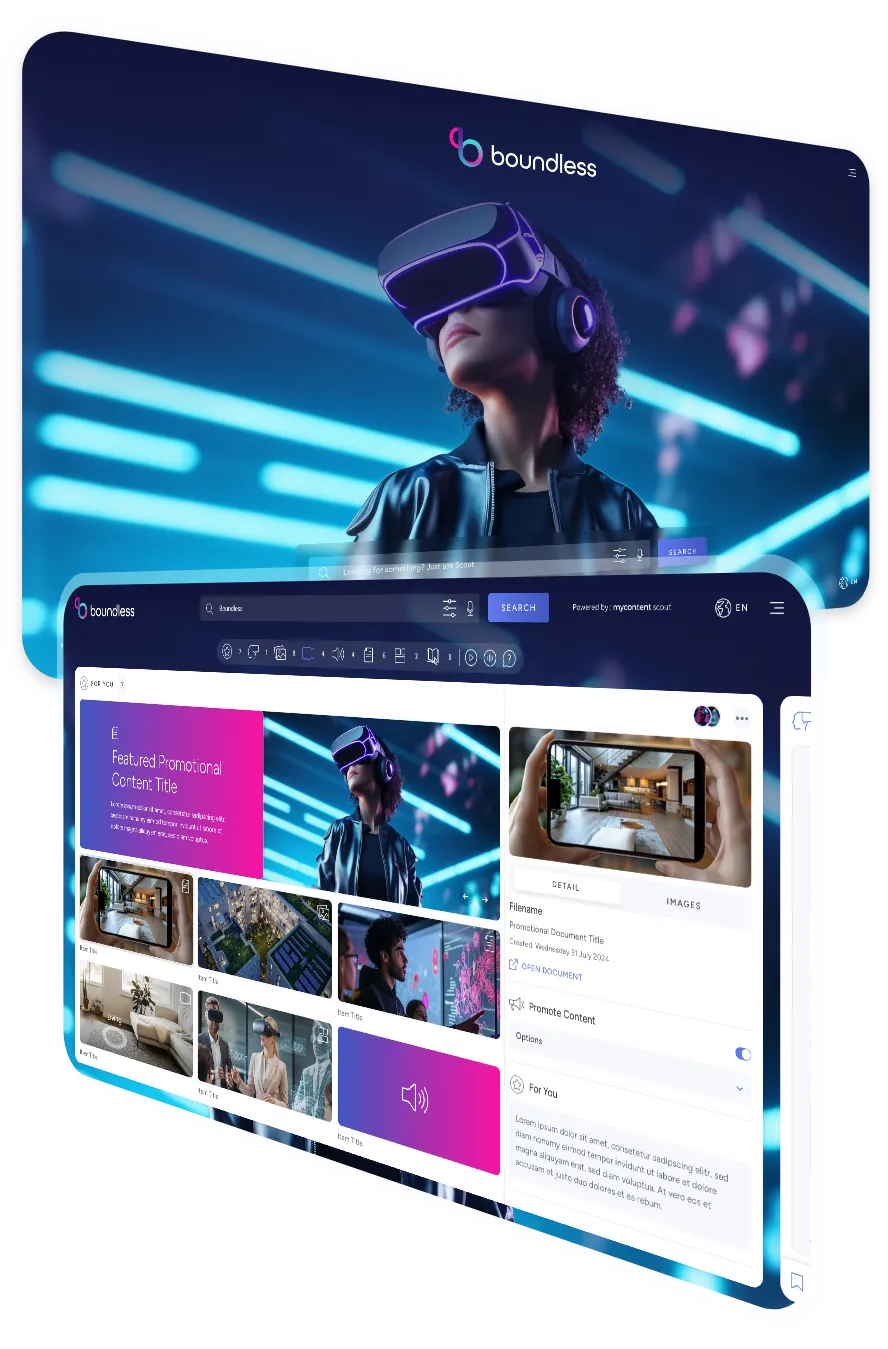
The phrase “AI” gets applied broadly enough that it’s worth being precise here. What MyContentScout does is not summarise the internet. It connects to the knowledge your organisation has already created documents, presentations, training videos, audio recordings, eLearning content, internal procedures and makes all of it searchable through a single, natural language question.
The distinction matters. When a new hire wants to know how to handle a particular customer escalation, they don’t search through four different folders and hope the right version surfaces. They ask a question in plain English and receive an answer drawn directly from the organisation’s own content, with the source attached so they can verify it.
This is what AI-powered knowledge management looks like when it’s applied practically: not a chatbot, not a wiki with a better interface, but a system that actively closes the gap between what your organisation knows and what your people can access at the moment they need it.
It removes the bottlenecks. It reduces the dependency on specific individuals. And it replaces the guesswork the “I think it’s in this folder” and the “you’d better ask Sarah” with precision.
One of the underappreciated dimensions of the knowledge access problem is format. Most organisations think of their knowledge as documents. In practice, a significant proportion of what teams know lives in formats that traditional search tools handle poorly or not at all.
A technical walkthrough recorded as a Teams call. A policy explained during an all-hands session, captured on video but never transcribed. A process guide built in PowerPoint and presented once, never revisited. A supplier briefing delivered as an audio recording.
All of this is knowledge. None of it is findable through a keyword search.
MyContentScout’s multi-format knowledge access is built specifically to address this. It surfaces answers from documents and spreadsheets, but also from video, audio, eLearning systems, images and presentations simultaneously. The format something was created in stops being a barrier to accessing what it contains.
For organisations that have invested years in building training libraries and operational content, this is where much of the unrealised value sits. The knowledge is already there. The platform makes it retrievable.
One of the most immediate and visible places the knowledge access problem shows up is in employee onboarding. New starters are productive to the degree that they can access the right information quickly. When that access depends on asking the right colleague at the right moment, onboarding becomes inconsistent, slow, and disproportionately dependent on whoever happens to be available.
The Society for Human Resource Management has documented the relationship between structured, accessible onboarding and time-to-productivity. The organisations that get new hires contributing quickly are, in most cases, the ones that have made their knowledge accessible rather than relying on ad hoc knowledge transfer.
When a new starter can ask a direct question about an internal process and receive the right answer sourced from the organisation’s own documentation from their first day, the dependency on individual colleagues as knowledge brokers reduces significantly. HR teams spend less time fielding repeat questions. Managers spend less time running informal onboarding sessions that weren’t in anyone’s plan.
Most leaders can quantify the obvious costs of turnover: recruitment fees, notice periods, handover time. The cost that doesn’t appear on any report is the knowledge that walks out the door and doesn’t come back and the productivity that quietly leaks while the team that remains tries to piece things back together.
According to industry research, employees can spend up to 30% of their working day searching for information. In a 250-person organisation, that figure represents an enormous volume of time redirected away from actual work, towards the act of trying to find out what the organisation already knows.
Organisational knowledge management is sometimes framed as a strategic nice-to-have. In practice, it’s one of the most direct levers available for improving productivity without adding headcount, reducing the risk that comes with staff turnover, and ensuring that the investment already made in creating knowledge continues to deliver value rather than sitting inaccessible in a folder nobody opens.
The most important thing to understand about solving the knowledge access problem is that it doesn’t require creating more content. The knowledge is already there. The procedures were written. The training was recorded. The decisions were documented somewhere.
What it requires is a system that makes all of it reachable not through navigation, not through keyword guesswork, not through asking a colleague but through a direct question that gets a direct answer, drawn from the organisation’s own verified sources.
If your business currently depends on what a handful of people know, it’s worth asking how long that’s sustainable, and what it would mean to change it.
👉 Start here: mycontentscout.com



Get in touch with our team to arrange a demo of MyContentScout and see how it could transform your workflow with AI search, content analysis and categorisation, saving you time and providing smart insights from various sources.