
Your team shouldn't need to remember the exact wording of a document just to find critical information.
The problem is so ordinary that most organisations don't notice it anymore. Someone needs a policy clarification, a contract clause, a technical specification, or a compliance detail. They head to the search bar and start guessing at keywords. And the clock starts ticking.
Think about what happens next. There's the time spent searching filenames. Then clicking through folders because the structure hasn't been updated in years. Then, after finally finding what might be the right document, more time validating that it's actually the right one. The text you're looking for is in there somewhere, you just need to find the exact page.
This adds up quickly. Our analysis shows the average knowledge worker spends approximately 20% of their work week searching for and gathering information rather than acting on it. That's not just an inconvenience. That's one full day, every single week, lost to information retrieval.
When your team is searching the way they have always searched, that cost multiplies across your entire organisation. Multiply it across every working day. Multiply it across departments where the inefficiency compounds.
Traditional enterprise search turns knowledge access into a guessing game. You guess at keywords. The system matches strings. And hope aligns somewhere in between.

Here's what separates modern information retrieval from what most organisations are still doing.
Your team understands intent. When an employee asks "What's our policy on remote equipment installation?" they're not searching for the phrase "remote equipment installation" buried in a document somewhere. They're asking a question. They want an answer. The distinction matters entirely.
McKinsey research on knowledge work productivity shows that the friction in accessing information isn't primarily a volume problem. Most organisations have the knowledge they need. The problem is that knowledge is fragmented across systems, buried in documents structured for storage rather than discovery, and indexed in ways that don't match how people actually think about problems.
When you search "policy remote equipment installation," a traditional system scans for those words. It might surface a document that mentions all three terms but is actually about something entirely different. Or it might miss the right document entirely because the policy is written using different language in a different section.
An AI-powered document search system understands what you're asking. It grasps context and intent. It surfaces the right information from contracts, reports, manuals, policies, and internal documentation without requiring you to predict the exact wording.
The result isn't just faster. It's accurate.

The experience transforms entirely.
Instead of hunting for keywords, employees ask natural questions. "Can we approve remote work requests on Fridays?" "What's the escalation path for critical incidents?" "Where do we document vendor onboarding?" The system understands the question and delivers an answer. Not a list of potentially relevant documents. An actual answer, grounded in your organisation's actual content.
No more guessing file names. No more clicking through endless folder hierarchies. No more wasting time validating whether you found the right document.
What emerges is a fundamentally different working experience. Knowledge stops being something your team hunts for. It becomes something that answers them immediately. And when the answer appears, you can see exactly where it came from: the specific document, the precise page or timestamp, the source material that backs it up.
For IT managers, this shift has immediate operational implications. The pressure on your team to maintain perfectly organised file systems disappears. The time spent fielding "where do I find X?" questions during onboarding drops dramatically. The complaints about search results being useless or time-consuming simply stop occurring.
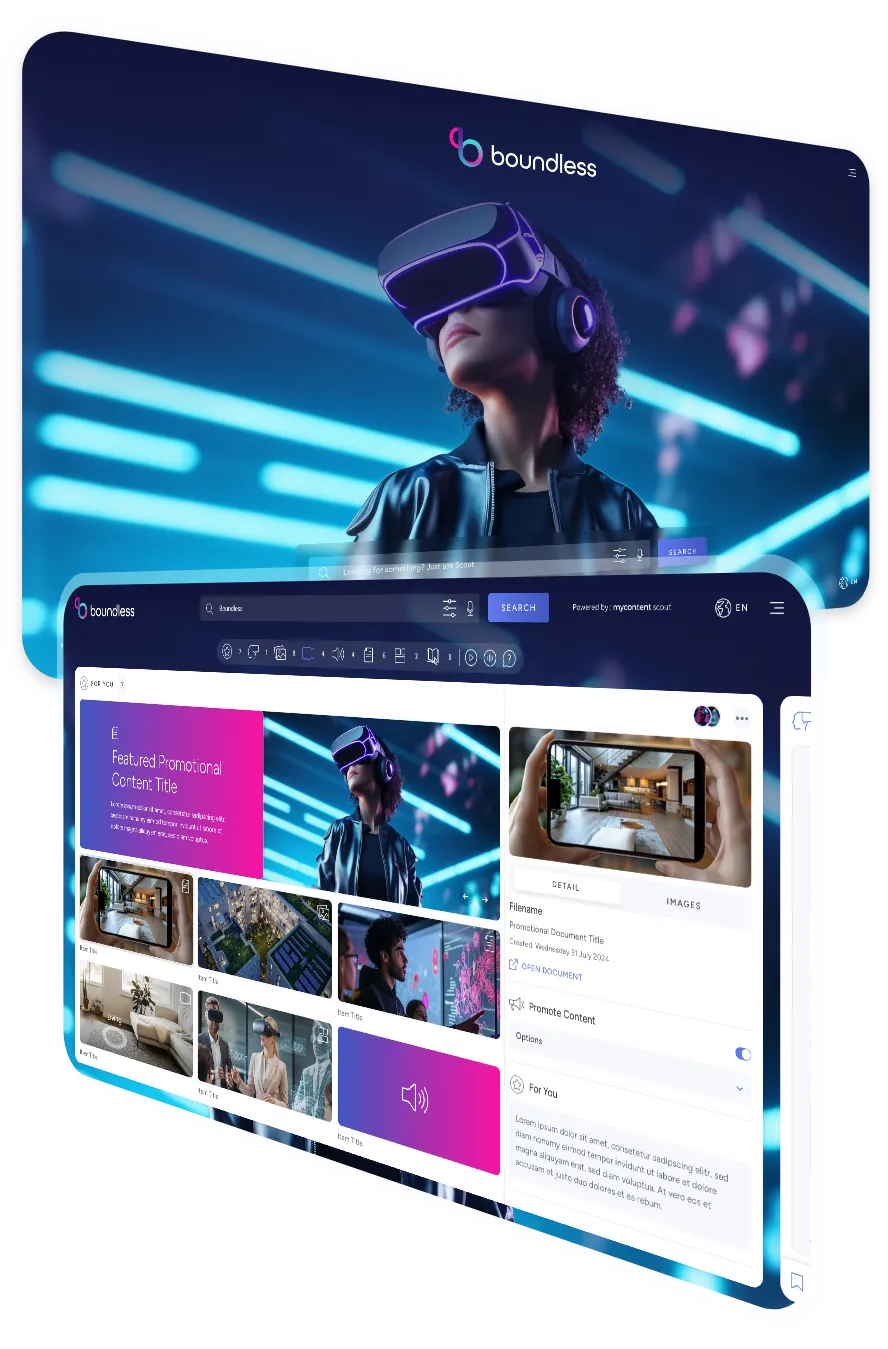
Advanced knowledge management platforms now analyse multiple content types simultaneously. Documents, yes. But also videos (searching every frame and every spoken word), audio files, images, dashboards, and e-learning materials. Everything exists within a single search interface.
That unified approach solves a real problem organisations face. Knowledge isn't stored in one place. Your employee handbook is a PDF. Your onboarding videos are hosted separately. Your policies are in a compliance management system. Your technical documentation is in a wiki. Your training modules are in an LMS. Each silo requires its own search. Each search requires its own logic and syntax.
A truly intelligent search system brings all of that together. You ask once. You get answers from across all of it.
The system also handles languages naturally. An employee asking in English gets answers from French documents. Someone searching in German finds content from Spanish videos. This matters more than it initially appears, particularly for distributed teams working across regions or for organisations supporting multilingual workforces.
When knowledge access improves, the effects ripple across the organisation in ways that surprise most IT leaders.
Onboarding accelerates. New hires don't spend days figuring out where information lives or how to find what they need. They ask questions and get answers. Training effectiveness increases because people can actually access what they were trained on without struggling with search syntax or folder structures.
Deloitte research on knowledge management reveals that organisations treating it as a strategic priority - rather than merely an IT infrastructure concern - see measurable improvements in employee productivity, faster decision-making, and stronger compliance. The critical factor is whether the system actually works well enough that people use it instead of reverting to informal workarounds.
That's the distinction worth noting. You can build an incredibly sophisticated knowledge base that nobody uses because searching it is painful. Or you can build something simple and intelligent that becomes the obvious first place your team looks for answers. The latter transforms how your organisation functions.
Consider the calculation from your organisation's perspective. If the average knowledge worker wastes one full day per week searching for information, and you have 200 employees, that's 200 work days per week disappearing into information retrieval. That's roughly 10,000 lost work days annually. Translated into salary costs at a modest £50,000 per employee, that's £2.5 million in annual productivity loss.
That number is specific to your organisation's size and cost structure, but the principle holds at any scale. The status quo has a price. Most organisations simply don't calculate it.
The transformation begins when you stop treating knowledge management as a technical problem to be solved and start treating it as a strategic capability to be developed.
An intelligent search system that understands context is part of that shift. It's not the entire solution. But it's the foundation. Because without access to knowledge, nothing else works. Your strongest processes remain locked away. Your best practices aren't actually practised. Your compliance controls are only as good as people's ability to find and follow them.
When your team can find answers instantly and naturally, knowledge stops being a constraint. It becomes a genuine competitive advantage. Your organisation moves faster because people spend less time searching and more time doing. Your compliance improves because policies are actually accessible when people need them. Your new hires become productive faster. Your team makes better decisions because they have the information they need, when they need it.
You don't need a complete transformation of your knowledge infrastructure overnight. Start by understanding the current state.
What's being searched repeatedly? Track the queries your team actually runs. Are the same questions appearing week after week? That pattern tells you something important. Either the content isn't satisfying the need, or the knowledge isn't being discovered even though it exists somewhere. Either way, it's a signal worth investigating.
What searches return no results? These are your content gaps. Someone needed something. The system came back empty. That's a precise, user-generated list of what's missing from your knowledge base. It's valuable information.
Where do people actually go for answers? If your team is asking colleagues before searching, asking your IT helpdesk for help finding things, or using external tools because your internal search is unreliable, that tells you the system isn't working the way it should.
These three observations paint a clear picture of whether your current document search solution is actually serving your organisation's needs.
The organisations winning in competitive markets increasingly recognise that knowledge access determines productivity as much as tools, talent, or process. When your team spends a quarter of their time hunting for information, your competitive advantage is compromised. When they can access what they need instantly, they're free to focus on what matters.
An intelligent knowledge platform that understands context isn't a convenience feature. It's operational infrastructure. It's how distributed teams stay aligned. It's how compliance becomes embedded in daily work rather than something people scramble to manage. It's how organisations scale without recreating the onboarding and training burden each time.
The technology to do this exists now. It's not a future capability. It's available today.
The only remaining question is whether your organisation is ready to make the shift from hoping people find the right information to ensuring they always do.
Ready to transform how your organisation accesses knowledge? Discover how AI-powered document understanding works in practice. Read the full feature breakdown or book a demo to see MyContentScout in action.





Get in touch with our team to arrange a demo of MyContentScout and see how it could transform your workflow with AI search, content analysis and categorisation, saving you time and providing smart insights from various sources.