%20(1).png)
There is a cost sitting inside most organisations that never appears on a budget report. It does not show up as a line item in the accounts, it does not trigger an alert in your project management tool, and nobody raises it in the quarterly review. But it is there every single day, in every team, across every department.
That cost is the time your people spend searching for information they need to do their jobs.
According to research from McKinsey Global Institute, employees spend an average of 1.8 hours per day - roughly 23% of their working week - searching for and gathering information. Across a typical working year, that adds up to more than nine hours every week, per person, lost not to distraction or disengagement, but to the basic friction of trying to find what they already should have access to.
For a mid-sized organisation, that friction carries a price tag. When you factor in salary costs, lost output, and the downstream effects of delays and errors, research published by IDC puts the cost of poor knowledge management at around $2.5 million per year for businesses of 1,000 employees or more. That is not a rounding error. It is a structural problem with a structural solution.

The challenge is rarely that the information does not exist. In most organisations, it does. It exists in policy documents saved to a shared drive nobody fully maintains. It exists in training videos recorded two years ago that newer starters have never watched. It exists in PDFs buried three folders deep, in audio recordings from onboarding sessions, in eLearning modules built for a software version that has since been updated.
The problem is not availability. It is how accessible it is.
Knowledge management as a discipline has existed for decades, but the tools most organisations rely on have not kept pace with how knowledge is actually created and stored. Folder structures made sense when documents were the only format. They make far less sense when your organisational knowledge is spread across videos, audio files, slide decks, PDFs, and digital learning content - all in different places, all requiring different tools to access.
The result is a daily experience most employees will recognise immediately. You know the answer exists somewhere. You just cannot find it quickly enough. So you ask a colleague, raise a ticket, wait for a reply, or make your best judgement with incomplete information and hope it holds.
Gartner reports that 47% of digital workers struggle to find the information they need to perform their roles effectively. Nearly half the workforce, in organisations that in many cases have invested heavily in content creation and documentation, still cannot reliably get to the knowledge they need when they need it.
The $2.5 million figure is striking, but the productivity statistics only tell part of the story. The rest of it shows how the daily experience of searching affects the people doing it.
When employees cannot find information quickly, the work does not just slow down. Quality suffers. Consistency breaks down. Different people find different versions of the same document and work from conflicting information. Junior employees, lacking the accumulated knowledge of longer-serving colleagues, make decisions from incomplete context. Experienced staff become informal answer services, fielding questions that should be answerable through a centralised system rather than through a phone call.
Research from Aberdeen Group has consistently linked knowledge accessibility to performance outcomes across service-based industries. Organisations that make technical and procedural knowledge easily retrievable see measurably better consistency in output quality — not because their people are more capable, but because they are better supported.
That support gap is at the heart of most knowledge access problems. The knowledge exists. The infrastructure to surface it, at the right moment, for the right person, in a usable form, is what is missing.
The phrase AI knowledge management gets used loosely, so it is worth being specific about what a well-built AI knowledge platform actually does differently from a search bar or a document repository.
A conventional keyword search looks for documents that contain the words you typed. It returns a list of files. You still have to open them, scan them, and work out whether they contain what you need. If your question is slightly different from the way the document was written, or if the answer sits in a video transcript rather than a typed document, the search may return nothing useful at all.
An AI knowledge platform, by contrast, understands the meaning of the question you are asking, not just the words. It searches across all of your content, documents, videos, audio files, eLearning modules, simultaneously. And it does not return a list of files to browse. It returns a direct answer, drawn from your organisation's own trusted content, with a citation so you know exactly where the information came from and can verify it if needed.
For a digital transformation programme, that distinction matters enormously. Uploading your documentation to a new system does not solve the knowledge access problem if the system still requires people to browse through it manually. Genuine improvement comes from making knowledge retrieval as fast and effortless as asking a question out loud, and getting a reliable, referenced answer in seconds.

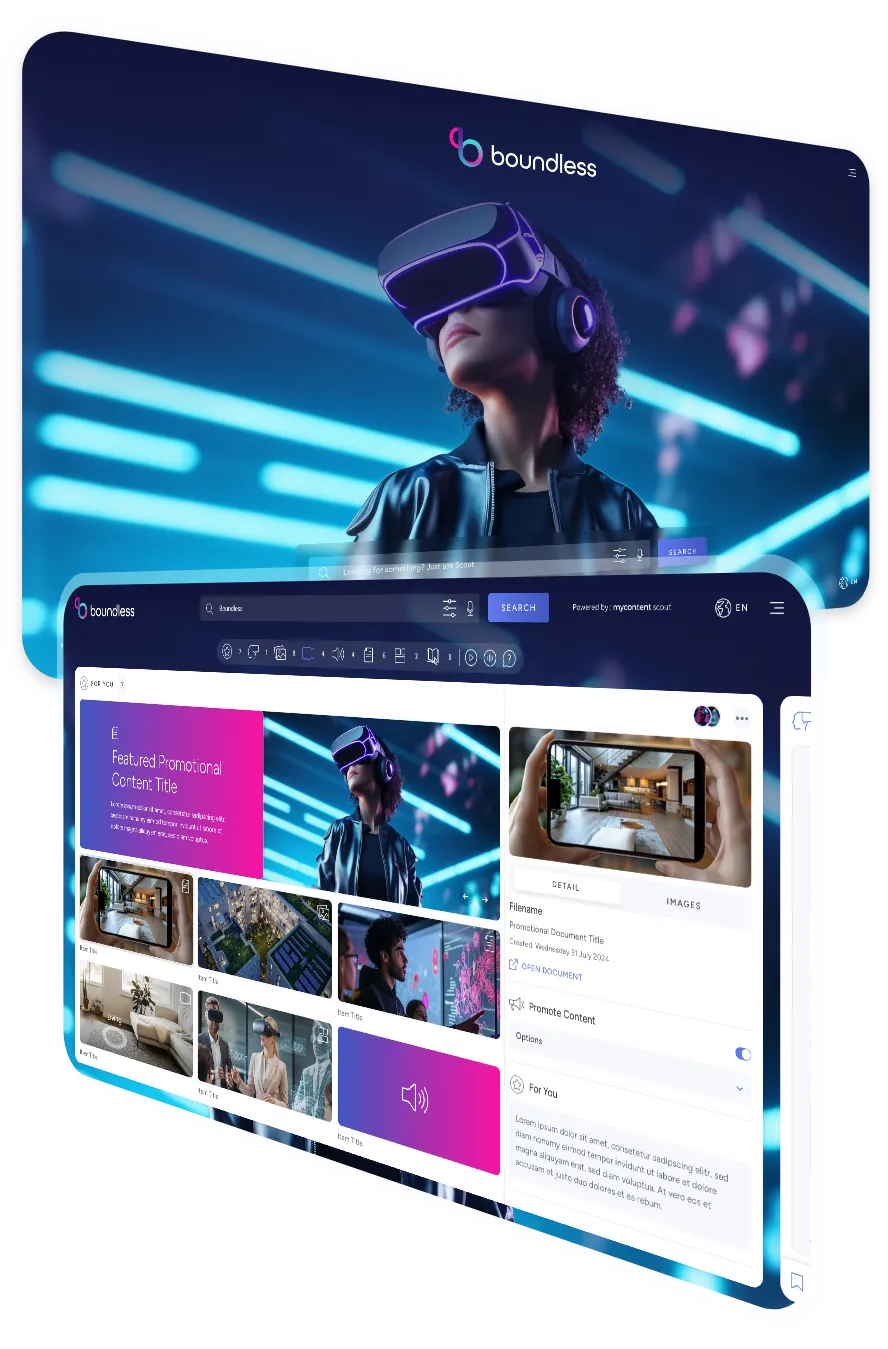
MyContentScout is an enterprise AI knowledge platform built around one principle: the knowledge your organisation has already created should be instantly accessible to everyone who needs it, regardless of the format it is stored in or the language they are asking in.
The platform works across your existing content library. You do not need to reorganise your folder structure, rebuild your documentation, or migrate to a new content management system. MyContentScout connects to what you already have, PDFs, Word documents, training videos, audio recordings, eLearning content, and makes it searchable through plain-language questions.
An employee looking for a compliance procedure types their question as they would ask it to a colleague. The platform searches across the entire content library, identifies the most relevant source material, and returns a cited answer drawn directly from your organisation's own documentation. The citation matters: it is not a generated summary that may or may not reflect what your documents actually say. It is an answer with a reference, so the person asking can check the source and act with confidence.
Multilingual support means the same knowledge base serves teams working in different languages, without requiring separate documentation for each. For organisations operating across multiple markets, that alone removes a significant overhead from the knowledge management function.
The value of reducing information retrieval time is not linear. When knowledge access improves, the benefits compound across the organisation in ways that are individually small but collectively substantial.
First-time resolution rates improve because people have the right information before they act, rather than after the fact. Onboarding accelerates because new starters can answer their own questions from day one, rather than relying on a shadow period with a more experienced colleague. Experienced employees get their time back, because they are no longer the informal answer service for everyone junior to them. Decisions improve in quality because they are made from complete, consistent, up-to-date information rather than whatever the person asking could locate in the time available.
For organisations that want to measure the return before committing, MyContentScout's ROI Calculator offers a straightforward way to quantify what that 23% of wasted time is actually worth to your specific operation. The numbers are usually more persuasive than the anecdote.
The first step is honest assessment. Most organisations know that their knowledge access could be better. Fewer have a clear picture of where the friction is worst, which formats are least accessible, or what the gap between their best-informed and least-informed employees actually looks like in operational terms.
If you are not sure where your knowledge infrastructure is weakest, MyContentScout's 2-Minute Knowledge Friction Assessment is a structured diagnostic built around the real operational situations organisations face. It takes around two minutes, requires no preparation, and returns a breakdown of where knowledge access problems are concentrated and what they are likely costing.
Your organisation has already done the work of creating its knowledge. The question is whether the people who need it can reach it. Less searching. More doing.
Start your free 30-day trial at MyContentScout or explore the full platform capabilities to see how AI-powered knowledge retrieval can work across your existing content.





Get in touch with our team to arrange a demo of MyContentScout and see how it could transform your workflow with AI search, content analysis and categorisation, saving you time and providing smart insights from various sources.