
There is a quiet productivity drain running through most organisations. It does not show up on a P&L, but it shows up everywhere else: in the inbox of the manager fielding the same question for the tenth time, in the new starter waiting three days for someone to send them the right onboarding document, in the support agent who gives a slightly different answer to the same customer query depending on which folder they happened to open first.
The problem is rarely a shortage of knowledge. The documents exist. The training videos were recorded. The procedures were written. What most teams lack is a fast, reliable route to the right piece of information at the moment they actually need it.
Research from McKinsey Global Institute found that employees spend an average of 1.8 hours every day searching for and gathering information. Across a team of twenty people, that is the equivalent of four full-time roles doing nothing but looking for things. The cost is not hypothetical. It is structural, and it compounds.
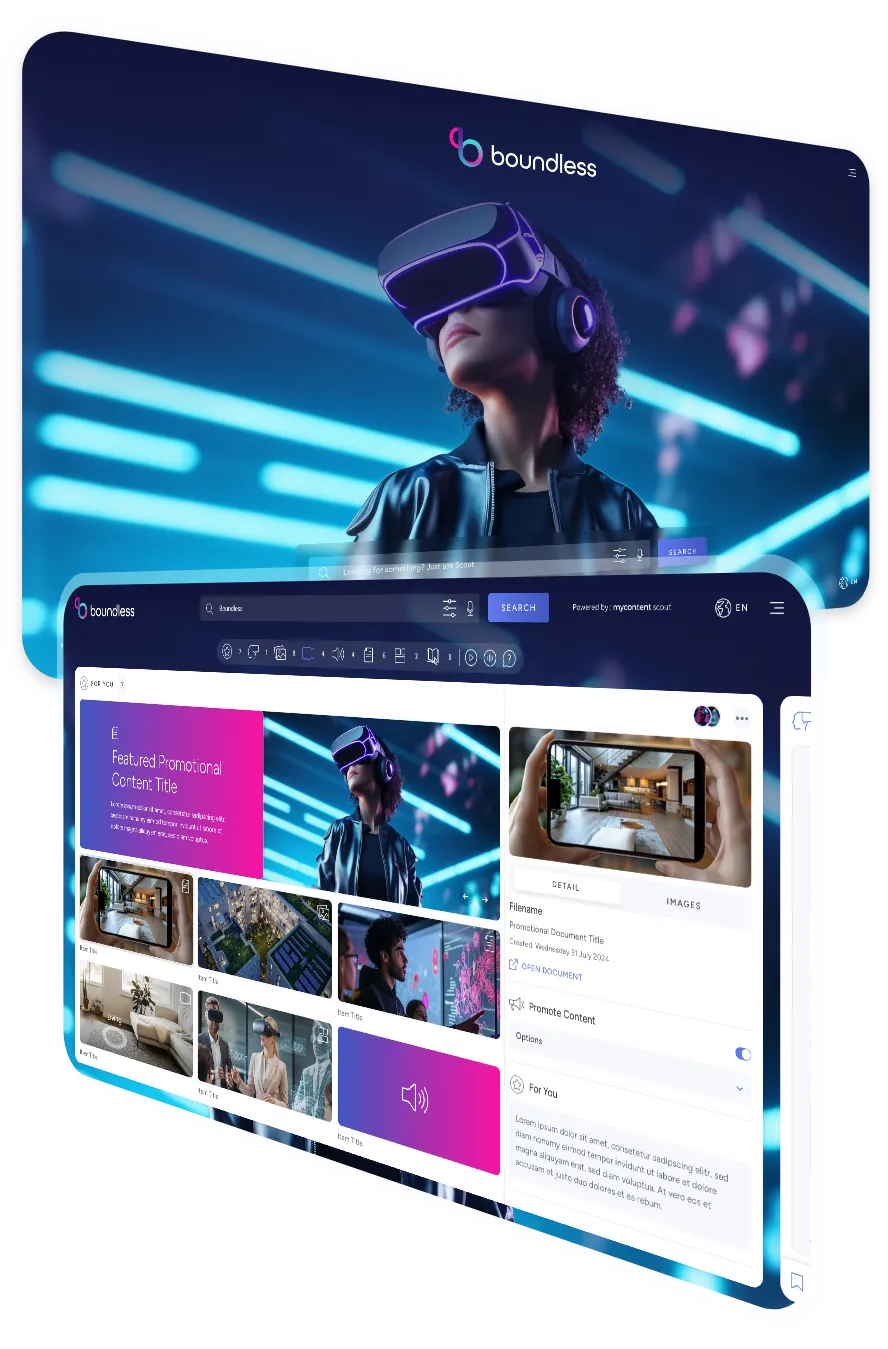
MyContentScout is built to close that gap. By connecting to the formats your organisational knowledge already exists in - documents, spreadsheets, videos, audio recordings, eLearning content and more - Scout gives every member of your team access to instant, source-backed answers through a single natural language question. No folder navigation. No version confusion. Just the answer, with the source to back it up.

Before looking at individual teams, it helps to understand the shape of the problem at an organisational level.
Knowledge in most organisations exists in layers. There is the formal layer: policy documents, technical specifications, training programmes. There is the informal layer: answers in email threads, procedures that live in a manager's head, institutional knowledge accumulated over years that has never been formally captured. And there is a vast middle ground of content that exists but is practically inaccessible because nobody can remember exactly what it is called, which system it lives in, or whether the version they found is current.
Gartner research found that 47% of digital workers struggle to find the information they need to do their jobs effectively. That figure is not a reflection of poor effort. It is a reflection of systems that were designed to store knowledge, not to retrieve it in the way real people actually ask questions.
AI-powered knowledge management changes the model. Rather than asking employees to navigate a structure someone else built, they can ask a question in the same language they would use with a colleague and receive a precise answer drawn from across every content source the platform is connected to. The distinction matters: it shifts the burden of retrieval from the employee to the system, which is where it belongs.
Operations teams carry enormous informational load. Procedures, compliance requirements, process documentation, supplier information, escalation guides - the volume of material an operations professional needs to access accurately and quickly is substantial.
When that information is scattered across shared drives, legacy systems and out-of-date intranets, decisions slow down. Processes get followed inconsistently because the authoritative version of a procedure is not clearly signposted. Time that should be spent optimising and delivering gets redirected into hunting.
MyContentScout's operations use case addresses this directly. Rather than navigating a folder hierarchy or relying on keyword search that returns fifty irrelevant results before the right one, an operations professional types a natural language question and receives the precise answer. The platform's knowledge analytics also surfaces patterns in what people are searching for, which helps operations leaders identify where documentation is thin, outdated or missing entirely.
The result is a team that spends less time looking and more time doing - with the confidence that the information they are acting on is accurate and current.
IT teams operate under constant pressure. The query volume is high, the range of issues is broad, and the expectation of fast resolution is consistent regardless of complexity.
Much of the information IT professionals need to resolve queries already exists - in technical documentation, previous case notes, vendor guides and internal knowledge bases. The challenge is accessing the right piece quickly enough to make a difference.
With MyContentScout's technical and innovation team capabilities, IT staff can ask a question and receive an answer drawn from across all connected sources, including content formats that traditional search tools handle poorly, such as recorded walkthroughs, audio briefings and eLearning modules. This matters because a significant proportion of technical knowledge in most organisations exists in video or audio format and is effectively invisible to keyword search.
Faster access to accurate information means shorter resolution times, lower backlog, and IT professionals spending more time on complex problems that genuinely need their expertise rather than repeating the same information retrieval exercise for routine queries.
The standard a customer support team is held to has risen substantially. Customers expect accurate, consistent answers regardless of which agent they speak to, which channel they use, or what time they make contact. Delivering that consistency when knowledge is fragmented across multiple systems is genuinely difficult.
MyContentScout for customer service teams creates a single, searchable knowledge base that agents can query in real time during a customer interaction. Rather than switching between tabs, consulting different platforms or making a best guess from memory, they type the question and receive the answer with its source attached.
This has a direct impact on two metrics that customer service teams care about most: resolution time and consistency. According to research cited by Deloitte, the ability to resolve issues quickly and correctly on first contact is the single biggest driver of customer satisfaction. A unified, instantly searchable knowledge base is one of the most direct levers available to support teams for improving that outcome.
The multilingual search capability built into Scout extends this further. Support teams serving customers or operating across different markets can ask questions in one language and retrieve answers from content in another, removing the language barrier from knowledge access entirely.
HR teams spend a disproportionate amount of time answering questions that have already been answered in writing somewhere. Policy queries. Benefit entitlement questions. Onboarding process steps. Procedure clarifications. The knowledge exists, but it is not accessible quickly enough for employees to find it independently, so the question lands with HR.
For onboarding specifically, this fragmentation has a measurable impact on time-to-productivity. Research on onboarding effectiveness from the Society for Human Resource Management indicates that structured, accessible onboarding significantly accelerates the point at which new hires begin contributing at full capacity.
MyContentScout for people and workforce teams gives new starters direct access to policies, procedures and training materials from their first day, without requiring a colleague to act as a guide. HR professionals can focus on the work that requires human judgement rather than acting as a directory for documents.
Role-based access control means that sensitive information - employment records, compensation data, confidential policy documents - remains accessible only to those with the appropriate permissions. Security is not a trade-off for accessibility; on Scout, both are handled by the same system.
The same knowledge access problem that affects Operations, IT, Support and HR plays out with equal force across marketing and engineering teams.
Marketing professionals need instant access to brand guidelines, campaign assets, content libraries and historical materials to ensure every output stays on-brand and every team member is working from current guidelines rather than a version from two campaigns ago. Engineering teams need quick retrieval of technical documentation, design specifications and project notes to avoid duplication, maintain standards and keep work moving forward.
In both cases, the underlying challenge is identical: knowledge exists but is not readily retrievable at the moment it is needed. Scout's multi-source intelligence, which searches across documents, images, video, audio and eLearning content simultaneously, means that regardless of the format a piece of knowledge happens to be in, it is findable through a single question.

Several features distinguish Scout from a standard enterprise search tool.
The platform understands natural language intent rather than matching keywords. You do not need to know what a document is called or which system it is stored in. You ask a question the way you would ask a colleague, and Scout interprets what you are looking for across every connected source.
The multilingual search capability means that a team operating across multiple markets can ask questions in one language and retrieve answers from content in another. For organisations with diverse workforces or international operations, this removes a significant barrier to knowledge access that most tools simply do not address.
Knowledge analytics surfaces patterns in how your organisation actually uses knowledge: what people are searching for, where searches fail to return useful results, which content areas have gaps. This is not just a usage report. It is a strategic tool for content owners and knowledge managers to continuously improve the quality and accessibility of organisational knowledge.
And because Scout integrates with your existing identity management infrastructure, access is both secure and frictionless. The right people reach the right content without additional login steps, and sensitive content stays protected without requiring a separate access management process.
Every hour a skilled professional spends searching for information rather than using it is an hour of value that does not reach a customer, a project, or a decision. Multiplied across teams and departments, the cumulative cost is substantial. The MyContentScout ROI calculator gives you a direct way to quantify that figure for your own organisation.
The investment in creating your organisational knowledge has already been made. The documents were written, the training was recorded, the procedures were built. The question is whether your teams can reach it when they need it.
If the answer is not a clear yes, it is worth exploring what changes when they can.
Request a demo and see how Scout works across your organisation's knowledge - or explore our blog for more on the strategic value of getting knowledge access right.





Get in touch with our team to arrange a demo of MyContentScout and see how it could transform your workflow with AI search, content analysis and categorisation, saving you time and providing smart insights from various sources.